Setting up a base isolation system in Bournemouth starts well before the structural engineer selects the bearings. We bring our in-situ CPT rig and dynamic sampling equipment directly to the site, often working on the Eocene sand formations that underlie much of the town. The CPT's 15 cm² cone penetrates the Bagshot Beds at a constant 20 mm/s rate, recording tip resistance, sleeve friction, and pore pressure every centimetre. This continuous profile is what the seismic analysis demands: no gaps, no disturbed samples, just a clean geotechnical log through the very strata that will transmit earthquake energy up into the building. Before any isolator catalogue is opened, the ground's shear wave velocity profile must be captured, typically by coupling a downhole geophone array into a borehole advanced alongside the CPT sounding, ensuring the Vs30 value accurately reflects the site class for Bournemouth's specific geological setting.
An isolation system is only as good as the soil spring it rests on. Without site-specific Vs profiles and dynamic soil properties, the bearing designer is working blind.
Service characteristics in Bournemouth
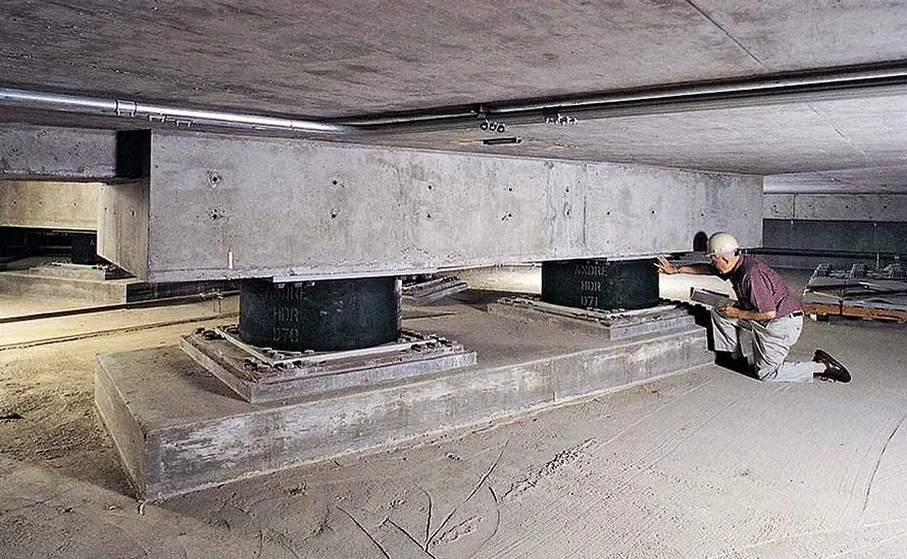
Typical technical challenges in Bournemouth
BS EN 1998-5:2004, Section 6, is unambiguous: the soil-structure interaction analysis for base-isolated buildings must use site-specific dynamic parameters, not default code spectra. In Bournemouth, this requirement is particularly relevant because the town straddles the boundary between the soft, compressible Bracklesham Group clays to the west and the denser Bagshot Sands to the east. An isolator designed for the stiff sand profile will perform entirely differently if the actual footprint encounters a clay pocket. The most consequential risk is period elongation: soft soils push the site period closer to the 2.0 to 3.0 second range where many isolation systems operate, creating a dangerous resonance scenario. Without seismic microzonation level investigation, the designer cannot verify that the effective period of the isolated structure — typically 2.5 to 3.5 seconds — remains sufficiently separated from the soil deposit's fundamental period. Liquefaction-induced loss of bearing under the isolator pedestals is another failure mode specific to Bournemouth's river terrace gravels where the water table is high, and this must be explicitly checked through liquefaction analysis before the isolation system geometry is finalised.
Our services
The geotechnical parameters required for base isolation design are not extracted from a single test. We deliver a sequenced investigation programme that builds the complete dynamic soil model from in-situ and laboratory data.
Site-Specific Seismic Site Classification
We measure Vs30 using downhole seismic or surface-wave MASW, assign the BS EN 1998-1 ground type (B through E), and deliver the elastic response spectra parameters for the Bournemouth site coordinates.
Dynamic Soil Property Testing
Our UKAS-accredited triaxial laboratory runs cyclic undrained tests on intact samples from the bearing stratum, producing G/G0 modulus reduction and damping ratio curves across the strain range required for non-linear time-history analysis.
CPT-Based Liquefaction Screening for Isolator Foundations
Using the NCEER/Youd-Idriss procedure adapted for CPT data, we calculate the factor of safety against liquefaction for each sand layer beneath the isolation plane, including post-earthquake settlement estimates.
Soil-Structure Interaction Parameter Report
We compile the impedance functions — static and dynamic stiffness, radiation damping coefficients — for the isolator foundation elements (spread footings or mat), formatted for direct input into the structural analysis software.
Common questions
What ground investigation is needed before specifying base isolation bearings in Bournemouth?
As a minimum, you need a site-specific Vs30 measurement (downhole or MASW) to assign the correct ground type per BS EN 1998-1, plus CPT or borehole data to at least 30 metres depth to identify any soft layers that could amplify ground motion. Where the isolation period is above 2 seconds, we also recommend cyclic laboratory testing on undisturbed samples to define the modulus reduction and damping curves for the bearing stratum. This three-part scope — Vs profile, stratigraphy, dynamic properties — gives the bearing designer the complete soil spring definition.
How much does a base isolation site investigation cost in Bournemouth?
For a typical residential or small commercial project, the combined CPT, downhole seismic, and dynamic laboratory testing programme ranges from £3,570 to £6,980, depending on the depth of investigation, number of cyclic triaxial tests required, and site access constraints. A site on the steep slopes of the Stour valley with limited rig access will be at the higher end due to the need for specialist tracked equipment and additional handling time.
Does BS EN 1998 require site-specific dynamic testing for base-isolated buildings?
Yes. BS EN 1998-5:2004, Section 6 and Annex D, explicitly requires that soil-structure interaction analysis for isolated structures use site-specific stiffness and damping parameters, not default code spectra. Section 10.3 of BS EN 1998-1 further requires that the design ground motion at the isolation plane account for local soil amplification, which can only be quantified through measured Vs profiles and, where soft soils are present, non-linear site response analysis. Relying on generic ground type assumptions without measured data is non-compliant for any building where isolation is being used as the primary seismic protection strategy.