The Eocene geology underlying Bournemouth creates a landscape where sandy strata alternate with clay lenses across the town's characteristic chines and coastal cliffs. The Branksome Sand Formation and Boscombe Sand Formation weather differently depending on moisture exposure, generating slope conditions that can degrade rapidly after heavy rainfall events. Our laboratory team performs direct shear and triaxial testing on undisturbed samples extracted from these formations to derive drained and undrained parameters for limit equilibrium modelling. When perched water tables develop within the sandy horizons, pore pressure conditions shift in ways that standard desktop studies miss. Complementing the laboratory programme with in-situ permeability measurements helps quantify drainage characteristics that control slope response during the Bournemouth wet season, while CPT profiling through the weaker clay bands identifies low-strength layers that often govern failure surface geometry.
Shear strength parameters derived from site-specific laboratory testing consistently reduce the uncertainty band in Factor of Safety calculations by 30 to 40 percent compared to published correlations.
Service characteristics in Bournemouth
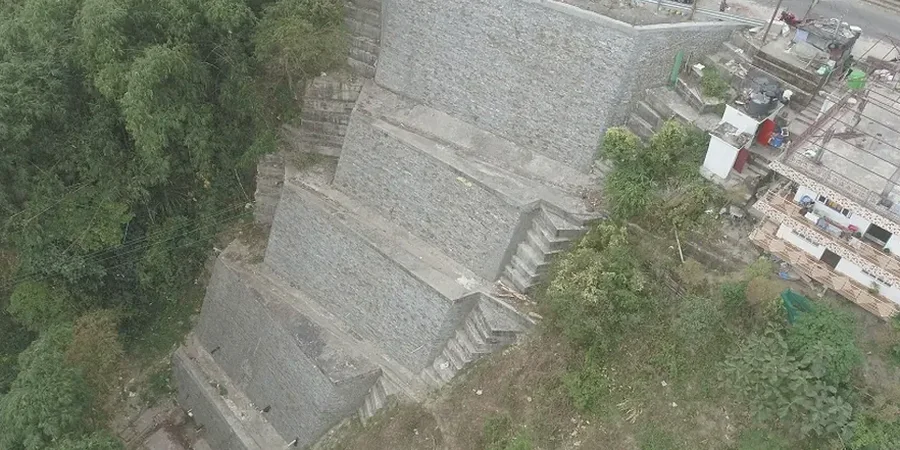
Typical technical challenges in Bournemouth
Eurocode 7 Design Approach 1 Combination 2 governs most slope stability assessments in the UK, applying partial factors to actions and material properties that require unfactored laboratory data as the starting point. Bournemouth's coastal cliffs present a particular challenge because BS EN 1997-1:2004 does not prescribe a single method for handling the transient pore pressure regime generated by tidal drawdown at the cliff base. Our laboratory programme addresses this by measuring soil-water characteristic curves on thin-wall tube samples, allowing the design team to model suction loss during drawdown cycles. The interaction between the permeable Branksome Sand and the lower-permeability Boscombe Clay at depth creates confined aquifer conditions in several chine valleys, where artesian pressures reduce effective stress along the slope toe. Ignoring this mechanism when interpreting laboratory strength data can overestimate the operational Factor of Safety by a significant margin. The BS 5930 framework requires that laboratory testing programmes be designed with full knowledge of the field groundwater regime, which is why we always review borehole piezometer records before finalising the testing schedule.
Our services
Our Bournemouth laboratory provides the full chain of testing and analysis works required to support a solid slope stability assessment, from intact sample preparation through to interpreted strength envelopes and stability model parameters.
Laboratory shear strength testing for slope design
Multi-stage triaxial and direct shear programmes on samples recovered from Bournemouth's Branksome Sand and Boscombe Clay formations, delivering peak, critical-state, and residual strength parameters formatted for direct input into limit equilibrium software.
Soil-water characteristic curve determination
Pressure plate and filter paper testing to define the relationship between matric suction and degree of saturation for Bournemouth's partially saturated cliff materials, supporting transient seepage and stability analyses under rainfall infiltration scenarios.
Common questions
How much does a slope stability analysis cost for a site in Bournemouth?
A complete laboratory testing programme with stability analysis typically ranges from £1,020 to £3,220, depending on the number of samples, the testing complexity, and whether unsaturated strength parameters are required. Sites with multiple slope profiles or deep failure surfaces fall at the higher end.
What laboratory tests are essential for a Bournemouth cliff stability study?
At minimum we recommend classification testing to BS 5930, multi-stage triaxial compression with pore pressure measurement, and direct shear on any identified clay interfaces. If the slope is above the water table, suction-controlled testing provides the unsaturated strength envelope that governs shallow failure mechanisms in the Branksome Sand.
How long does the laboratory programme take before we receive design parameters?
Standard triaxial and direct shear programmes are reported within three to four weeks from sample receipt. Programmes requiring suction-controlled testing or ring shear determination of residual strength add approximately one to two weeks. We always discuss project timelines at the quotation stage to align the testing schedule with design milestones.
Can you test samples from existing boreholes or do you need to supervise the drilling?
We can test samples provided by any drilling contractor, but sample quality directly controls the reliability of the resulting parameters. For slope stability work where strength anisotropy matters, we recommend having our technician present during sampling to verify that thin-wall tube recovery meets the Class 1 requirements of BS EN 1997-2.