The ground beneath Bournemouth tells two very different stories depending on where you stand. Down toward the seafront and Boscombe Pier, the geology is dominated by the Branksome Sand Formation—clean, wind-blown sands that can extend 30 metres deep and behave very differently under load than the clay-with-flints and plateau gravels you encounter up toward Winton and Charminster. We have seen preliminary site investigations in the town centre where standard borehole recovery was poor in the sand, and the decision to switch to CPT (Cone Penetration Testing) saved the project weeks of delay. The cone penetrates these sands with minimal disturbance, recording cone resistance and sleeve friction every few centimetres, which gives our geotechnical engineers a continuous profile of the strata. For sites near the River Stour where soft alluvium overlies the sand, combining CPT data with triaxial testing helps validate the undrained shear strength parameters before foundation design begins.
In clean Branksome Sand, a single CPT sounding can replace three or four boreholes for stratigraphic profiling—saving time without sacrificing data quality.
Service characteristics in Bournemouth
Typical technical challenges in Bournemouth
A 14-storey residential block planned on a former car park near the Lansdowne showed clean sand in the first three CPT soundings, but the fourth—closer to the old Bourne Stream culvert—hit a 2-metre band of soft organic silt at 8 metres depth. The qc values dropped below 1 MPa in that layer, and the friction ratio spiked above 4%, which flagged a potential compressible layer that the initial desk study had not predicted. Without that fourth sounding, the pile design length would have been too short, and differential settlement could have appeared within the first five years of occupation. This is the reality of coastal towns like Bournemouth: buried paleochannels and former watercourses are common, and they rarely appear on historical maps. A CPT grid with adequate density is the only practical way to catch these features before construction begins.
Our services
Every CPT campaign we run in Bournemouth is tailored to the specific ground conditions and the questions the structural engineer needs answered. The two core configurations we offer cover most project requirements.
Standard CPT with pore pressure measurement (CPTu)
A full piezocone profile logging qc, fs, and u2. Includes friction ratio calculation and soil behaviour type classification using the Robertson (1990) chart. Ideal for sites where the water table is high—common anywhere within 500 metres of the seafront—and where pore pressure data is needed for effective stress analysis.
CPT with dissipation testing
We stop the cone at predetermined depths and record the decay of excess pore pressure over time. From the t50 value, we estimate the coefficient of consolidation in both horizontal and vertical directions. This is particularly requested for projects involving basement excavations or cut-and-cover works in the saturated sands found across the Bournemouth coastal plain.
Common questions
How much does a CPT test cost in Bournemouth?
For a single CPT sounding to a depth of 15 to 20 metres in the Bournemouth area, you can expect to pay between £130 and £180 per linear metre, which covers the rig, the operator, and the full data report. The final cost depends on access conditions, the number of soundings, and whether dissipation tests are required. A typical three-sounding investigation on a residential plot tends to fall in the £5,000 to £8,000 range including mobilisation.
Can CPT replace boreholes entirely on a Bournemouth site?
In the clean sands that dominate much of the Bournemouth geology, CPT can replace a significant portion of the borehole programme—particularly for stratigraphic profiling and liquefaction assessment. However, if the site investigation encounters gravel lenses in the plateau gravels or requires undisturbed samples for laboratory testing, a targeted borehole or two is still good practice. We usually recommend a hybrid approach: CPT for continuous profiling across the site, with one or two boreholes to recover samples where the cone hits refusal or where index testing is needed.
How deep can a CPT rig penetrate in Bournemouth sands?
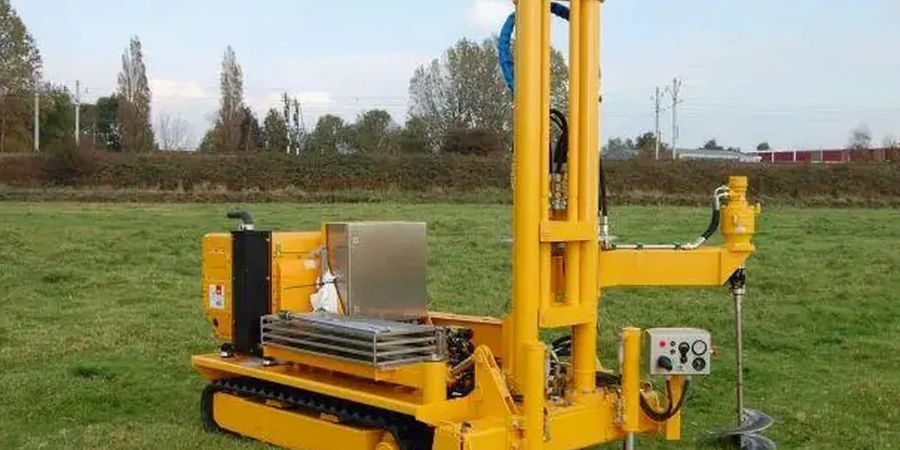
Our 20-tonne rig typically reaches 25 to 30 metres in the Branksome Sand Formation before reaching practical refusal, provided there are no dense gravel layers. In the plateau gravels up toward Talbot Woods, refusal can occur much shallower—sometimes at 5 to 10 metres—when the cone encounters tightly packed flint cobbles. We always assess the anticipated geology before quoting a target depth.
What is the difference between CPT and SPT for foundation design?
CPT gives a continuous, high-resolution profile of soil resistance, whereas SPT provides a single N-value every 1.5 metres. In the sands of Bournemouth, where thin silt layers can control settlement behaviour, the continuous CPT trace is far more revealing. That said, many UK foundation design methods are still calibrated to SPT N-values, so we often deliver an N60 equivalent derived from the cone resistance, which lets the structural engineer work with familiar parameters while benefiting from the CPT's superior detail.
Do you need traffic management for CPT testing on Bournemouth roads?
Yes, for any CPT work on the public highway—whether it is a main road like the A338 Wessex Way or a residential street in Southbourne—you will need a permit from BCP Council and a traffic management plan. Our team handles the permit application and can arrange the TM contractor, so the client does not need to manage that separately. The rig footprint is compact enough that we can often work within a single lane closure.