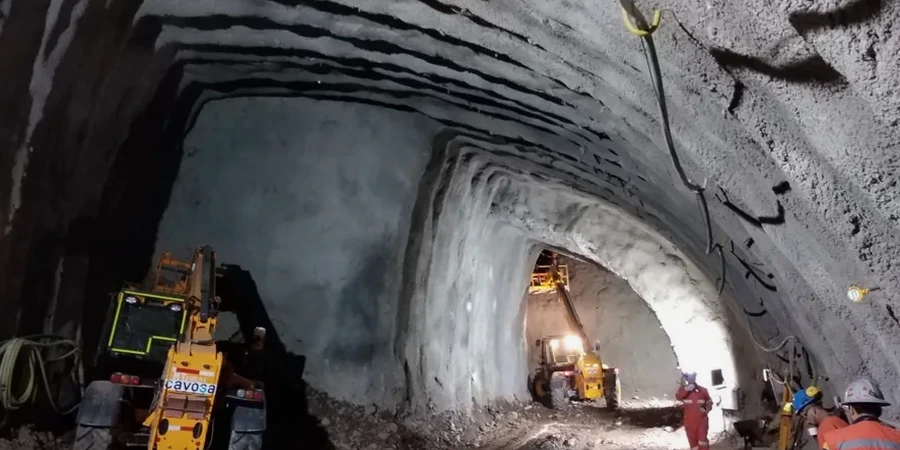
Underground excavations in Bournemouth encompass a broad range of geotechnical engineering activities essential for creating safe, stable subterranean spaces. This category covers everything from initial ground investigation and laboratory testing through to detailed design, construction supervision, and long-term monitoring of tunnels, shafts, basements, and cut-and-cover structures. The importance of specialist underground excavation expertise in Bournemouth has grown significantly with the town's ongoing urban regeneration, the need for coastal infrastructure resilience, and the increasing density of development along the South Coast. Whether for transport tunnels, deep sewerage systems, or multi-storey basement constructions in constrained urban plots, a thorough understanding of local ground behaviour is critical to managing risk, controlling ground movements, and protecting adjacent assets.
Bournemouth's geology presents a distinctive set of challenges for underground works. Much of the town centre and coastal fringe is underlain by the Branksome Sand Formation, part of the Poole Formation, comprising fine to medium sands with occasional clay and silt lenses. These granular soils can be loose to medium dense and are often saturated given the high groundwater table near the coast and the River Bourne. Further inland, the London Clay Formation and the Bagshot Beds introduce stiff, overconsolidated clays that demand different excavation and support strategies. The transition zones between these strata, together with buried channels and variable weathering profiles, create complex ground conditions that require sophisticated geotechnical analysis for soft soil tunnels to predict face stability, settlement troughs, and the risk of running ground.
All underground excavation projects in Bournemouth must comply with the UK's robust regulatory framework. The primary standard is BS EN 1997-1:2004+A1:2013 (Eurocode 7: Geotechnical design – Part 1: General rules) and its UK National Annex, which mandate a limit state design philosophy. For temporary works, BS 5975:2019 provides the code of practice for falsework and excavation support, while the Construction (Design and Management) Regulations 2015 (CDM 2015) place clear duties on clients, designers, and contractors to manage health and safety risks throughout the project lifecycle. Where excavations could affect Network Rail assets, the stringent requirements of Form F001 and the relevant Network Rail standards also apply. A robust geotechnical design of deep excavations must demonstrate compliance with these standards, particularly regarding the assessment of ground movements and their impact on nearby structures.
Typical projects requiring underground excavation works in Bournemouth include the construction of deep basements beneath new residential and commercial developments in areas like West Cliff and Lansdowne, where space is at a premium. Tunnelling for utility diversions, surface water storage, and combined sewer overflows to reduce storm discharges into Poole Bay is increasingly common, driven by Environment Agency consents. Coastal defence schemes, such as the construction of deep pump stations and outfall tunnels, also demand careful excavation sequencing and groundwater control. Across all these project types, effective geotechnical excavation monitoring is indispensable, providing real-time data on wall deflections, ground settlements, and pore water pressures to validate design assumptions and trigger contingency measures if trigger values are approached.
Common questions
What are the main geotechnical risks when excavating underground in Bournemouth's sandy soils?
The primary risks in Bournemouth's Branksome Sand include running ground and instability at the tunnel face or excavation sides due to loose, water-saturated conditions. High groundwater levels near the coast increase the likelihood of base heave and piping. Adjacent structures can suffer settlement damage if dewatering or ground loss is not tightly controlled, making rigorous monitoring and pre-support measures essential.
Which British Standards apply to the design of deep excavations in the UK?
Deep excavation design in Bournemouth must follow BS EN 1997-1 (Eurocode 7) and its UK National Annex for geotechnical limit states. BS 5975:2019 governs temporary works and falsework. For groundwater control, BS 8102:2022 covers waterproofing, while CIRIA guides such as C760 deliver best practice for embedded retaining walls. CDM 2015 regulations also impose overarching safety duties.
How is ground movement monitored during underground excavation projects?
Monitoring typically combines precise surveying of surface settlement points, inclinometers in retaining walls to measure lateral deflections, and piezometers to track pore water pressure changes. Tilt meters on nearby buildings and vibration monitors are often added in urban areas. Automated total stations can deliver real-time alerts if movements approach predefined trigger levels, allowing immediate mitigation.
What types of underground excavation projects are most common in Bournemouth?
Common projects include deep basements for hotels and residential blocks in central Bournemouth, utility tunnels for sewer and surface water storage, and coastal outfall tunnels. Cut-and-cover metro or road underpasses, though less frequent, also fall under this category. Each demands tailored geotechnical analysis, temporary works design, and construction-phase monitoring to manage the specific ground and groundwater conditions.