The coastal geology around Bournemouth creates a real challenge for earthworks. You can dig a metre down in Boscombe and hit clean sand, then move half a mile west toward the Chines and suddenly find silty clay lenses that hold water for days. That variability, shaped by the Pleistocene river terraces and wind-blown brickearth deposits, makes a standard visual classification completely unreliable. A proper grain size analysis—sieve plus hydrometer—tells you exactly what you are dealing with before you commit to a foundation design or a cut-and-fill strategy. We run the full curve from 75 mm gravel down to the 2-micron clay fraction, following BS 5930 and BS EN 1997-2, so the contractor gets a defensible soil description that the building control officer accepts without pushback. For projects near the cliff lifts or the seafront, where groundwater is a constant variable, the hydrometer data often reveals a plasticity risk that the naked eye simply misses. That level of detail is what keeps earthworks programmes on schedule in this town.
A single grading curve replaces a dozen assumptions—and in Bournemouth's mixed coastal soils, assumptions are what trigger variation orders.
Service characteristics in Bournemouth
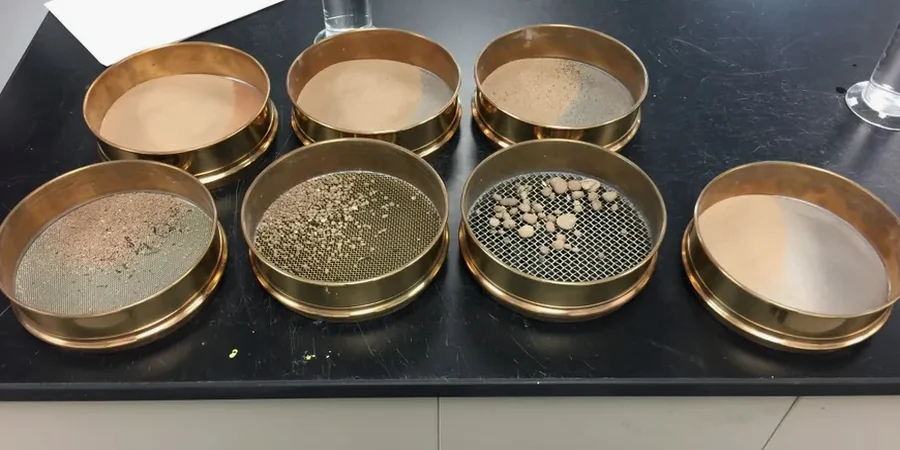
Procedure video
Typical technical challenges in Bournemouth
The most common mistake we see on Bournemouth sites is assuming that a clean-looking sand has zero fines. A contractor excavates, sees pale yellow material, calls it sand, and proceeds with a drainage design that assumes high permeability. Six months later the paving is holding water and the landscape architect is asking uncomfortable questions. A simple wash-through on the 63-micron sieve often reveals 8–12% silt content that changes the hydraulic conductivity by an order of magnitude. When you skip the hydrometer, you miss the clay fraction entirely, and that is where the real trouble sits—clay governs shrink-swell behaviour, frost heave susceptibility, and long-term settlement. Bournemouth's winter rainfall, averaging 80–90 mm per month between November and February, turns a poorly drained silty sand into a construction nightmare. For larger projects near the A338 or the university campus, where slope stability becomes a design consideration, the grading curve feeds directly into the effective stress parameters used in the slope model. Getting the particle size distribution wrong at the start means every downstream calculation carries an error you cannot see until something moves.
Our services
Our Bournemouth laboratory runs both standard and specialist grading suites for local ground investigation consultants and civil contractors. Each analysis includes a full data sheet with the grading curve plotted on a semi-log chart, plus interpretation notes relevant to the site geology. We can also coordinate sample collection from your Bournemouth site if required.
Sieve Analysis (Coarse Fraction Only)
Dry or wet sieving from 75 mm down to 63 µm. Suitable for clean sands and gravels where fines content is expected to be below 10%. Delivered with full tabulated results and a particle size distribution curve.
Combined Sieve + Hydrometer Suite
Full grading curve covering gravel to clay. Includes wet sieving, hydrometer sedimentation analysis, and calculation of uniformity coefficient (Cu) and coefficient of curvature (Cc). Recommended for all Bournemouth sites with silty or clayey layers.
Common questions
When does a Bournemouth project need the hydrometer test instead of just a sieve analysis?
If visual inspection shows any material sticking to your fingers when moist, or if the wash-through on a 63-micron sieve captures more than a thin film of fines, you need the hydrometer. Bournemouth's brickearth and alluvial deposits commonly carry 15–35% silt and clay, and without the sedimentation data you cannot assess frost heave potential or drainage behaviour properly.
What does a combined sieve and hydrometer analysis cost?
For a single sample tested to BS 5930, the combined suite typically runs between £80 and £140 depending on sample condition and whether expedited turnaround is required. We deliver a fixed quote before any work starts.
How much soil do you need for a full particle size distribution test?
For a combined sieve-and-hydrometer run, we ask for about 2 kg of material in a sealed bag. If the sample contains gravel larger than 20 mm, we may need up to 5 kg to ensure the coarse fraction is representative.
Can you test samples that have been sitting in the site cabin for a few weeks?
Yes, but we need to know the storage conditions. If the sample has dried out, we record that on the report. Oven-dried samples are fine for sieve analysis, but the hydrometer test works best on material that has not been artificially dried, as heating can alter the clay fraction behaviour.
How do I interpret the D10, D30, and D60 values on the grading curve?
D10 is the particle diameter at which 10% of the sample is finer—it is the 'effective size' used in permeability estimates and filter design. D60 divided by D10 gives the uniformity coefficient (Cu); a Cu below 3 indicates a poorly graded soil, while above 15 suggests a well-graded material. D30 squared divided by (D10 × D60) gives the coefficient of curvature (Cc), which should fall between 1 and 3 for a well-graded soil. Our reports include all three values with a brief interpretation.