The British coastline presents ground conditions you do not encounter inland, and Bournemouth is a textbook example. With the implementation of BS 5930:2015 and Eurocode 7 (BS EN 1997-2:2007), a soil mechanics study here must account for the Chalk Group bedrock, overlying Bracklesham Beds, and extensive plateau gravels that define the local geology. The real challenge is the transition zone between the permeable Bagshot Sands and the underlying London Clay, where perched water tables create pore pressure anomalies. We typically see this in the northern suburbs toward Kinson and Ensbury Park, where foundation design without a proper soil mechanics study becomes a gamble. Our laboratory runs consolidated-undrained triaxial tests under UKAS accreditation to derive effective stress parameters for these exact strata. Before breaking ground near the River Stour floodplain, we recommend integrating a test pit investigation to visually log the gravel-clay interface and a CPT campaign for continuous profiling through the softer alluvial layers.
Effective stress analysis on Bournemouth's Bracklesham Beds often reveals friction angles between 28° and 34°, but the key is the cohesion intercept change with saturation.
Service characteristics in Bournemouth
Typical technical challenges in Bournemouth
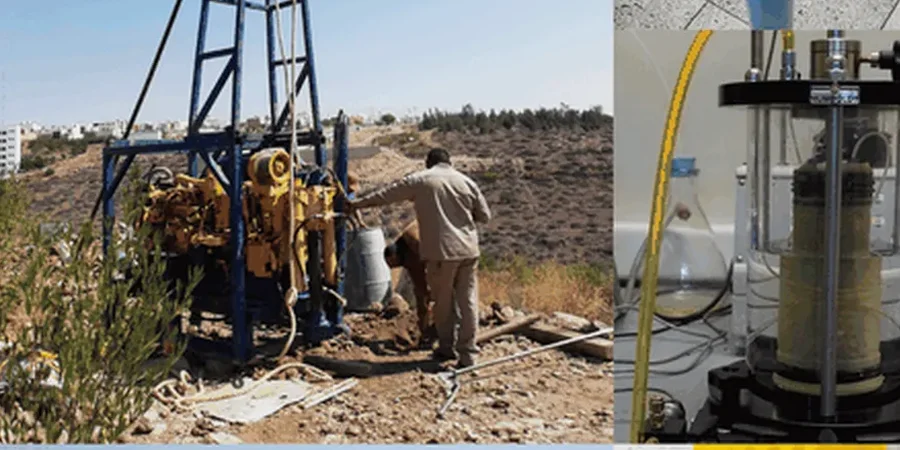
Our field crews arrive in Bournemouth with a tracked dynamic sampling rig capable of windowless sampling through the gravels and rotary coring into chalk. The risk we mitigate with a soil mechanics study is not just bearing failure: it is the differential settlement across a site where chalk pinnacles sit five metres from a clay-filled dissolution pipe. This karstic feature is common along the Christchurch Road corridor, where historic boreholes often miss the variability if spacing exceeds 15 metres. A soil mechanics study that includes a dense grid of dynamic probes, followed by selected sampling at critical locations, catches these transitions. Without it, a raft foundation can tilt within the first year of loading. We also test for sulfate and pH on chalk samples because Class DS-4 or DS-5 conditions demand sulfate-resisting cement, a specification detail that becomes expensive to retrofit.
Our services
The scope of a soil mechanics study in Bournemouth depends entirely on the geological unit encountered. We design phased investigations that start with a desk study of BGS mapping and end with a parameter report ready for the structural engineer.
Bournemouth Chalk & Cohesive Soil Testing
Triaxial (CIU, CAU, CD) and oedometer testing on chalk and London Clay samples under UKAS-accredited procedures. We report effective stress parameters, preconsolidation pressure, and chalk grade per BS 5930, including point load index and saturation moisture content.
Plateau Gravel & Sand Formation Analysis
Shear box and relative density testing on the Branksome Sand and plateau gravels. We determine peak and residual friction angles for slope stability and footing design, alongside BRE SD1 chemical aggressivity profiling for buried concrete.
Common questions
How much does a soil mechanics study cost for a residential project in Bournemouth?
For a typical residential plot with a couple of boreholes, lab testing on selected samples, and a factual report to BS 5930, the cost ranges from £2,560 to £4,010 plus VAT. The final figure depends on access constraints, chalk depth, and whether you need a full interpretive report with bearing capacity and settlement calculations.
Do I need a soil mechanics study for a rear extension in Bournemouth?
Building Control will almost always ask for a ground investigation report if the extension is within 5 metres of a drain, tree, or existing foundation. In Bournemouth, the shallow chalk in areas like Winton means you can have refusal at 1.2 metres on one side of the plot and 4 metres of sand on the other. A targeted soil mechanics study prevents underpinning surprises.
What is the difference between a soil mechanics study and a standard site investigation?
A site investigation logs what is there; a soil mechanics study tests how it behaves under load. We measure shear strength, compressibility, and permeability through triaxial and oedometer tests, then model it with effective stress. This gives your structural engineer the design parameters needed to comply with Eurocode 7 Geotechnical Category 2.
How long does the lab testing phase take in Bournemouth?
Standard classification tests (moisture content, Atterberg limits, particle size distribution) take 5–7 working days. Triaxial and oedometer tests, which require saturation and consolidation stages, need 10–15 working days. We can accelerate with an express surcharge if the contractor is waiting on a foundation design.