Bournemouth sits on a geological boundary that catches out plenty of designers who only look at regional maps. The northern suburbs rest on stiff Bagshot Sands, while the coastal strip and the Bourne Valley run through soft alluvium and river terrace gravels. That contrast means a raft foundation behaves completely differently depending on which side of the Wessex Way you are building on. We have seen projects where differential settlement reached 25 mm across a 15-metre span simply because the bearing stratum dipped mid-footprint. A properly calibrated CPT test gives us the continuous profile needed to position the raft neutral axis where it actually works, not where the textbook assumes it should be. For sites with buried chalk at shallow depth, we often combine the raft analysis with a seismic refraction survey to map the rockhead before committing to a thickness.
A raft foundation on Bournemouth's valley alluvium needs a subgrade modulus profile, not a single value. The difference between edge and centre can exceed 40 percent.
Service characteristics in Bournemouth
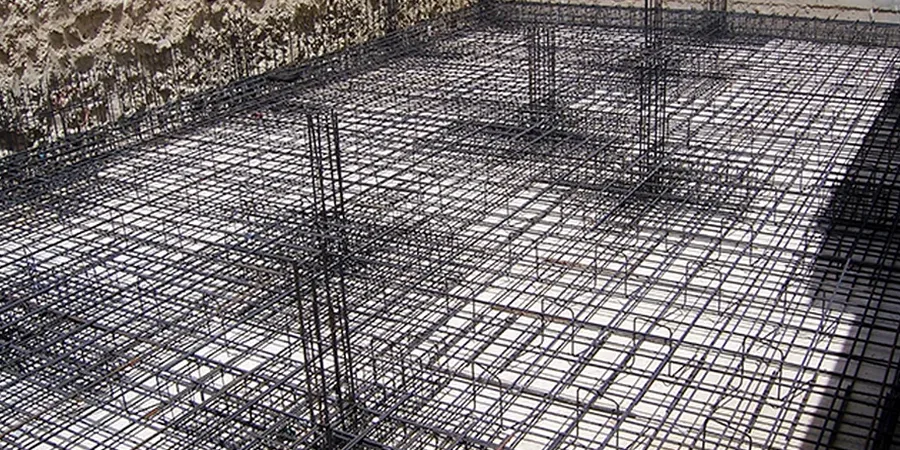
Key elements of our approach include: site-specific bearing capacity assessment under eccentric loading; settlement analysis using the Mayne-Poulos method for sands; and structural design of the slab to BS EN 1992 with subgrade reaction modulus calibrated from plate load tests on the actual formation level. When the water table is within 1.5 metres of the underside, we add a drainage blanket and check for hydraulic uplift during construction, a detail the building inspector in Bournemouth will expect to see in the submission package. The raft thickness rarely exceeds 500 mm for residential work on the Bagshot Beds, but on the valley alluvium we have specified up to 850 mm with edge beams deepened to 1.2 m where soft clay lenses were confirmed by undrained triaxial testing.
Typical technical challenges in Bournemouth
We reviewed a four-storey apartment scheme on the old gasworks site near the railway station where the developer had assumed uniform ground because the trial pits looked consistent. The site investigation missed a 2-metre-wide band of made ground running diagonally under the footprint, old backfill from a demolished gasholder. On a raft, that soft strip would have created a hinge line and cracked the slab within two years. We mapped it with a combination of dynamic probing and targeted test pits, then redesigned the raft with a local thickening and two layers of reinforcement across the transition zone. Bournemouth has dozens of former industrial plots like this, especially in the Triangle and Lansdowne areas, where the ground has been reworked multiple times since the Victorian era. Skimping on investigation depth leaves you designing a raft for conditions that exist only in the borehole log, not under the actual slab.
Our services
Our Bournemouth projects typically require a tight integration between site investigation and structural analysis. We deliver two core packages that cover the full design workflow from ground characterisation to reinforcement detailing.
Raft Foundation Design Package
Full design to BS EN 1997 and BS EN 1992 including bearing capacity, settlement analysis with modulus variation across the footprint, structural design of the slab and edge beams, uplift check where required, and a Construction Issue drawing package. We calibrate the subgrade reaction modulus from CPT or plate load data collected on your site.
Integrated Site Investigation for Mat Foundations
Boreholes, CPT soundings, and laboratory testing programme designed specifically for raft analysis. We determine the stiffness profile, identify soft spots that would govern differential settlement, and produce the geotechnical parameters the structural engineer needs: modulus of subgrade reaction, undrained shear strength, and consolidation characteristics.
Common questions
What ground conditions in Bournemouth require a raft foundation instead of strip footings?
Rafts become the preferred option on the soft alluvium of the Bourne Valley, on made ground in the town centre, and anywhere the bearing stratum varies significantly across the footprint. The Bagshot Sands generally support strip footings well, but if the sand thins and gravel lenses appear, a raft distributes the load and reduces differential settlement. Sites with a water table within 1.5 m of formation level also favour rafts because they deliver a single, continuous excavation base.
How do you determine the modulus of subgrade reaction for a Bournemouth site?
We do not use a single value from a textbook table. Subgrade reaction modulus is not a soil property, it depends on the size and stiffness of the raft. We derive it from CPT cone resistance data using the Robertson method for sands, or from plate load tests on the actual formation. For sensitive sites on alluvium, we run a parametric study with upper and lower bound values and design the slab for the worst-case differential settlement condition.
What is the typical cost range for raft foundation design in Bournemouth?
For a residential or small commercial building, the design package including all calculations and drawings typically falls between £860 and £3,220 depending on footprint complexity, number of load cases, and whether we are also managing the site investigation. A straightforward rectangular raft on competent Bagshot Beds is at the lower end. A large, irregular footprint on valley alluvium with uplift analysis and multiple construction stages is at the upper end.
Do you handle the Building Control submission for raft foundations?
Yes, the design package includes a full Geotechnical Design Report to BS EN 1997-1:2004 with the calculation pack, which is the format Bournemouth Building Control expects. We also deliver the structural calculations to BS EN 1992 and can respond directly to any technical queries raised during the plan-check process.
How deep does the site investigation need to go for a raft foundation?
We follow BS 5930 and BS EN 1997-2 and take the investigation to a depth of at least 1.5 times the raft width below formation level. For a 10-metre-wide raft, that means 15 metres of penetration. If chalk is encountered shallower, we core into it to prove competence. The key is getting below the zone of influence where the stress increase drops below 10 percent of the applied load.