Bournemouth's growth through the Victorian era placed heavy demands on its coastal infrastructure, and today's push to upgrade utilities and transport links beneath the town faces a familiar headache: the ground. The geology here isn't uniform. You get pockets of soft Bracklesham clay sitting next to sandy Bagshot Beds, with groundwater levels that shift with the seasons. Running a TBM or even a sequential excavation through that mix without proper geotechnical analysis is asking for trouble. The lab team routinely deals with core samples from boreholes sunk along the Christchurch Road corridor and around the Lansdowne area, where developers need to know exactly how the soil will behave before they commit to a tunnelling method. When the brief calls for verifying stiffness at depth, we pair lab data with field results from a CPT test to catch thin soft lenses that borehole logs alone can miss.
We map the transition from sand to clay metre by metre — Bournemouth's geology doesn't come in neat, predictable layers.
Service characteristics in Bournemouth
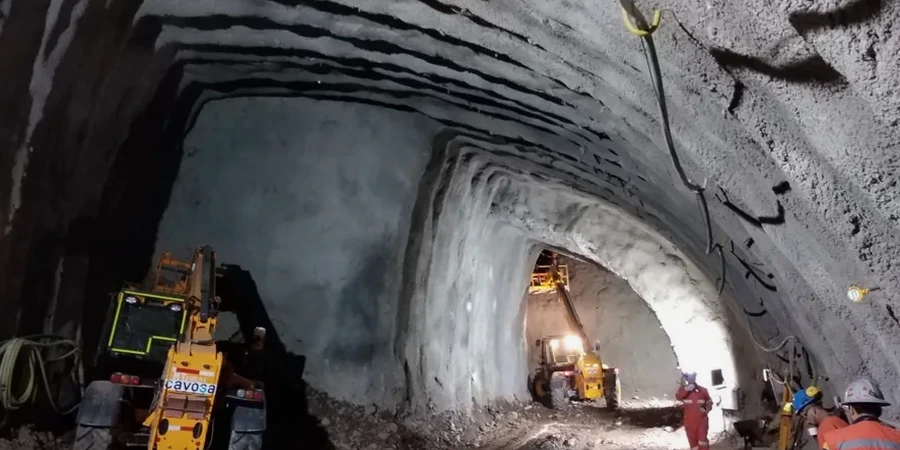
Typical technical challenges in Bournemouth
One thing the lab keeps seeing in Bournemouth is that the soft clays aren't always where the borehole logs from the 1970s say they are. The town sits on a sequence of dipping strata, and a 20-metre shift in alignment can put you into a completely different material. Groundwater is another variable that catches people out: perched water tables in the sandy layers can sit above the regional aquifer, and if the tunnel invert breaches that lens, you get a sudden inrush that no amount of dewatering from the surface will fix. The biggest single risk is face loss in mixed-face conditions. When the cutterhead is half in sand and half in stiff clay, the torque differential can destabilise the excavation within minutes. A solid geotechnical analysis that characterises the soil at the face every few metres isn't optional — it's the difference between a controlled drive and a sinkhole on Wessex Way.
Our services
The laboratory programme for a soft-ground tunnel in Bournemouth goes well beyond a simple classification test. We run the full suite of strength, stiffness, and durability tests that a designer needs to model face stability, settlement, and lining loads.
Triaxial testing (CIU, CAU, UU)
Consolidated undrained and unconsolidated undrained tests on U100 and UT100 samples to determine effective stress parameters for undrained and drained tunnel face analysis.
Oedometer consolidation tests
Incremental loading oedometer to derive compression index, swelling index, and preconsolidation pressure — critical for predicting short and long-term settlement over the tunnel crown.
Particle size distribution and Atterberg limits
Full gradation by wet sieving and sedimentation, plus liquid and plastic limits, to classify the material and flag potentially problematic silts and clays.
Groundwater chemistry and aggressivity
Analysis of pH, sulphate, chloride, and magnesium concentrations in accordance with BRE Special Digest 1 to determine the appropriate concrete mix design and reinforcement cover for tunnel linings.
Common questions
What ground investigation data does the lab need to start a soft soil tunnel analysis?
We work from site investigation records: borehole logs with SPT N-values, U100 or UT100 undisturbed samples, groundwater monitoring data, and in-situ test results if available (CPT, pressuremeter). The lab can receive samples directly from the drilling contractor. For a typical Bournemouth tunnel project, we recommend samples at 1.0 to 1.5 metre vertical intervals within the tunnel horizon and at least 3 metres below invert level.
How do you handle mixed-face conditions in the testing programme?
Mixed-face conditions — where the tunnel face cuts through two or more distinct materials — are common in Bournemouth's Bagshot-Bracklesham transition zones. We test each material separately and then deliver a combined interpretive report that highlights the engineering contrast. The key parameters are the stiffness ratio between the two materials and the difference in permeability, because that drives the face pressure differential during TBM operation.
What is the typical cost for a geotechnical analysis for a soft soil tunnel?
The fee for a comprehensive soft-ground tunnel testing programme typically falls between £3,590 and £13,300, depending on the number of samples, the test schedule required, and whether advanced triaxial or consolidation testing is specified. A small-diameter microtunnel with a limited sample set sits at the lower end; a full TBM drive with multiple cross-sections and a complete suite of strength, stiffness, and chemistry tests will be at the upper end. We deliver a fixed-price proposal once the borehole plan and sample count are confirmed.
Which British Standards apply to tunnelling geotechnical analysis?
The core standard is BS 5930:2015+A1:2020 for ground investigation practice, together with Eurocode 7 (BS EN 1997-2:2007) for the design of geotechnical structures. Laboratory testing follows the BS EN ISO 17892 series. For tunnel-specific guidance, designers frequently reference CIRIA C760 for embedded retaining walls and the AGS format for data transfer between the lab and the design team.