Retaining wall design in Bournemouth intersects directly with BS EN 1997-1:2004 and the National Annex, but the real engineering challenge lies beneath the surface. The town sits on a geological transition zone where Barton Clay, Branksome Sand, and Plateau Gravel interleave unpredictably across short distances. This patchwork stratigraphy creates differential bearing pressures and variable drainage behaviour that generic designs cannot address. A reinforced concrete cantilever wall that performs perfectly on the gravel terraces of Talbot Woods may require complete re-engineering just half a mile south where the sand becomes loose and saturated. Our design approach integrates site-specific CPT testing to map these transitions continuously, eliminating the interpolation gaps that SPT-based assumptions introduce in heterogeneous profiles.
A retaining wall on Bournemouth's Barton Clay without adequate drainage will fail—not from structural inadequacy, but from hydrostatic pressure the original design never anticipated.
Service characteristics in Bournemouth
Typical technical challenges in Bournemouth
The most persistent error we encounter in Bournemouth retaining wall failures is the assumption that Branksome Sand drains freely and therefore pore pressure behind the wall is negligible. This sand formation contains silt laminae and iron-cemented layers that act as internal aquitards, trapping perched water after sustained rainfall. Bournemouth receives over 800 mm of rain annually, and a wall with undersized weep holes or missing gravel drainage blanket will develop hydrostatic heads exceeding design assumptions within the first winter. We have reviewed forensic reports where walls designed with zero water pressure showed horizontal displacement of 40-70 mm within two years, accompanied by cracking in adjacent masonry. The remedy is straightforward but non-negotiable: a continuous drainage zone of clean angular gravel, a filter geotextile meeting MARV requirements, and weep holes at 1.5 metre centres minimum. For walls retaining Barton Clay, we additionally specify a sand drainage layer on the retained side to accelerate consolidation and reduce long-term lateral pressures.
Our services
Our Bournemouth retaining wall design works span the full project lifecycle, from feasibility assessment through to construction phase monitoring. Every design package includes a Geotechnical Design Report (GDR) structured to Eurocode 7 requirements, with clear documentation of all assumptions, partial factors, and verification calculations.
Gravity and cantilever wall design
Reinforced concrete retaining walls designed to BS EN 1992-1-1 with stem, toe, and heel proportions optimised for Bournemouth's gravel and sand bearing strata. Includes bearing capacity, sliding, overturning, and global stability checks.
Embedded retaining wall analysis
Sheet pile and secant pile wall design for basement excavations in the town centre, using WALLAP or FREW for soil-structure interaction analysis. Incorporates construction staging and temporary propping requirements.
Reinforced soil and crib walls
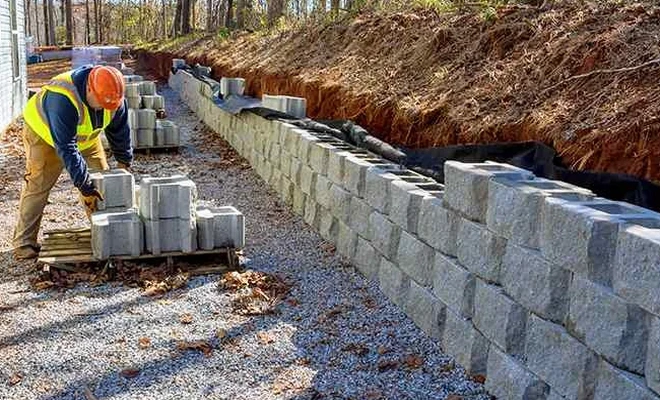
Segmental block and gabion wall solutions for landscape applications on the sloping sites of Talbot Woods and Branksome Park, with geogrid reinforcement lengths verified by internal and external stability analysis.
Drainage and waterproofing design
Comprehensive drainage system specification including filter geotextile selection, granular drainage blanket gradation, weep hole spacing calculations, and tanking system design for habitable basements per BS 8102:2009.
Common questions
What retaining wall types are most suitable for Bournemouth's coastal geology?
The answer depends entirely on retained height and ground conditions. For heights under 3 metres in Branksome Sand, reinforced concrete cantilever walls deliver cost-effective performance with straightforward construction. In Barton Clay areas, we lean toward embedded solutions like sheet piles because they bypass the bearing capacity concerns that heavy gravity walls introduce. For tiered gardens on the steep slopes around the Chines, gabion walls offer flexibility and free drainage that suit the sandy-gravelly soils. The key is matching wall type to drainage regime—Bournemouth's geology demands free-draining systems wherever possible.
How much does retaining wall design cost in Bournemouth?
Design fees for retaining walls in Bournemouth typically range from £900 for a straightforward gravity wall under 2 metres to £3,680 for complex embedded walls requiring soil-structure interaction analysis and construction staging. The fee includes the Geotechnical Design Report, structural calculations, and construction drawings. Ground investigation costs are separate and depend on access constraints and investigation depth.
Do I need planning permission for a retaining wall in Bournemouth?
Under the Town and Country Planning Act, retaining walls exceeding 1 metre in height adjacent to a highway, or 2 metres elsewhere, generally require planning permission. Bournemouth, Christchurch and Poole (BCP) Council also has specific policies for the East Cliff and West Cliff conservation areas that may impose additional restrictions on materials and visual impact. We always recommend checking with BCP planning department before finalising design scope.
How do you verify that the design assumptions match actual ground conditions during construction?
We specify observational method protocols aligned with CIRIA C760. During excavation, our geotechnical engineer inspects the exposed strata to confirm soil type, strength, and drainage characteristics match the ground investigation data. If discrepancies arise—such as encountering Barton Clay where Branksome Sand was expected—we adjust the design before concrete placement. This verification step prevents the most common cause of retaining wall underperformance in Bournemouth: building to a design that assumed correct ground conditions without ever validating them.
What design life do you specify for retaining walls?
For permanent retaining walls, we design to a 50-year service life in accordance with BS EN 1990 and BS 8500-2 exposure classes. In Bournemouth's coastal environment, concrete cover and mix design must account for XS1 (airborne chlorides) exposure within 500 metres of the seafront, and XC3/XC4 carbonation risk throughout the town. We specify minimum cover of 50 mm to reinforcement for cast-in-place concrete in these conditions, with C40/50 concrete as standard for durability.