Coastal Bournemouth presents two very different ground profiles within a few hundred metres: the firm Bagshot Beds underlying the northern suburbs around Charminster and Winton, and the soft, water-laden alluvial deposits closer to the River Stour and Christchurch Harbour. A foundation scheme that works perfectly on the gravelly plateau may fail entirely on the saturated silts less than a mile south. Stone column design bridges this gap, providing a reliable ground improvement method that transfers structural loads through weak strata to more competent layers beneath. The technique involves installing compacted gravel columns that densify the surrounding soil and create stiff, load-bearing inclusions. Our approach draws on site-specific CPT data and in-situ permeability testing to model drainage conditions before installation, ensuring the design accounts for pore pressure dissipation rates unique to Bournemouth’s estuarine margins.
A stone column is not a pile; it relies on lateral confinement from the soil it displaces. Get the modulus contrast wrong, and you lose that confinement.
Service characteristics in Bournemouth
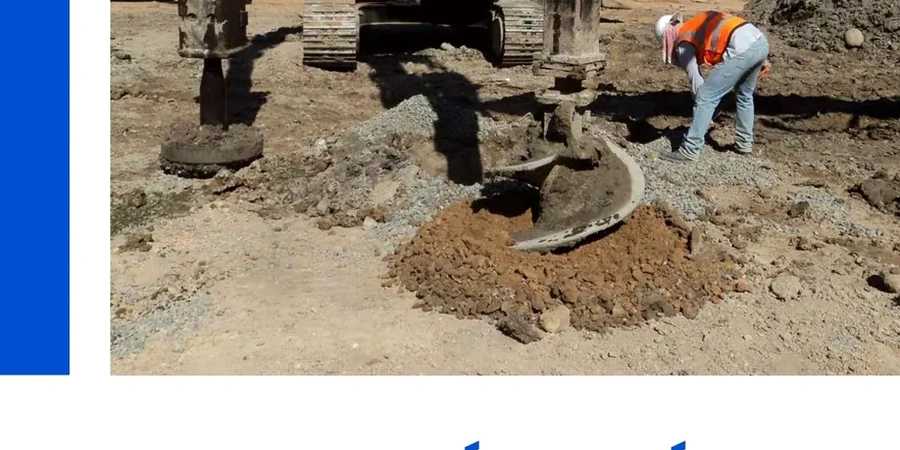
Procedure video
Typical technical challenges in Bournemouth
The most common mistake on Bournemouth’s soft-ground sites is specifying a uniform grid spacing without accounting for the transition zones between alluvium and terrace gravels. A column array that performs adequately in homogeneous silt can leave a weak corridor at the geological boundary, where differential settlement cracks superstructure walls within the first two years. Another recurrent problem is underestimating smear effects during vibroflot penetration in laminated soils; the remoulded zone around each column can temporarily reduce radial drainage capacity, delaying consolidation and skewing post-installation settlement predictions. We mitigate these risks by running a sensitivity analysis on column stiffness and spacing across the footprint, and by requiring pore pressure monitoring during the dissipation phase on sites where the groundwater table sits within 1.5 metres of the working platform.
Our services
Our stone column design package for Bournemouth covers the full workflow from feasibility to validation, adapted to the site’s specific ground investigation data and structural loading requirements.
Feasibility Assessment and Preliminary Design
Review of ground investigation reports, identification of treatment depths, estimation of area replacement ratios, and preliminary settlement analysis using Priebe or FEM methods to confirm viability before mobilisation.
Detailed Execution Drawings and Method Statement
Grid layout plans with column numbering, depth schedules per column, aggregate specification, sequence of installation, and quality control hold points aligned with BS EN 14731.
Post-Installation Verification and Load Testing
Design of zone load tests on single columns and groups, specification of CPT or DMT verification between columns, and interpretation of results against the acceptance criteria defined in the design report.
Common questions
What ground conditions in Bournemouth are best suited to stone columns?
The method works well in the soft alluvial silts and loose sands found along the Stour Valley and near Christchurch Harbour. It is particularly effective where the undrained shear strength exceeds 15 kPa and the fines content is below 25%, allowing the columns to develop adequate lateral confinement. Sites underlain by the Branksome Sand Formation also respond favourably when vibroflot penetration is achievable.
How much does stone column design cost for a typical Bournemouth project?
For a standard residential or light commercial site, the design package including feasibility analysis, detailed layout, and verification specification typically falls between £1,290 and £4,280, depending on the number of columns, the complexity of the loading, and the extent of post-treatment testing required.
How do you verify that the columns have achieved the design stiffness?
Verification combines modulus-based testing with load-deformation measurement. We specify CPT soundings at the centroid between columns to confirm the increase in tip resistance and sleeve friction relative to pre-treatment values. Zone load tests on single columns, using reaction beams or kentledge, deliver direct settlement data that we back-analyse against the Priebe-calculated improvement factor.
What is the typical settlement reduction achievable with stone columns?
Settlement reduction ratios depend on the area replacement ratio and the stiffness contrast between the column and the surrounding soil. In Bournemouth’s alluvial profiles, we commonly achieve a reduction factor between 3 and 10, meaning a structure that would settle 30 mm untreated can be limited to 3 to 10 mm after improvement, provided the grid spacing and column depth are correctly calibrated.