A contractor came to us last year with a problem on a site near the Lansdowne. They needed to go down three levels for an underground car park but hit groundwater at just two metres. The original design hadn't accounted for the hydraulic pressure in the Poole Formation sands, and the shoring was already showing signs of distress. That is the reality of deep excavation work in Bournemouth. The coastal geology here is unforgiving. A desk study alone won't cut it. You need a geotechnical design that understands the local sand layers, the fluctuating water table, and the tight site access that defines much of this town. We combine thorough site investigation data, often from CPT testing to get a continuous profile of the sands, with solid numerical modelling to predict wall deflections before the first bucket hits the ground. Getting the temporary works right is everything — because in Bournemouth, the margin between a dry excavation and a flooded one is often just a few hundred millimetres of head difference.
In Bournemouth's coastal sands, the success of a deep dig is defined by how well you manage groundwater before you move any soil.
Service characteristics in Bournemouth
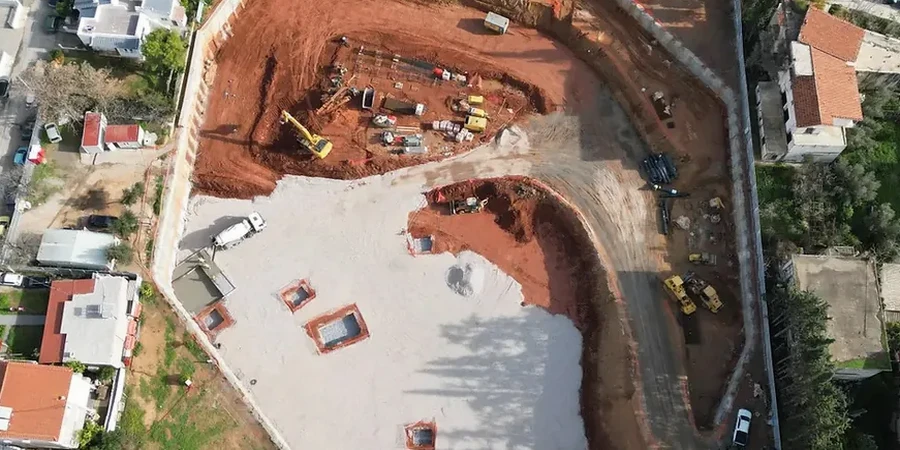
Typical technical challenges in Bournemouth
The rigs we mobilise for deep excavation support in Bournemouth need to be compact but powerful. A Klemm KR 709 or a similar restricted-access piling rig is often the only thing that can fit through the gate of a former hotel site being redeveloped into flats. The biggest technical risk we see is not the excavation itself but what happens to the buildings next door. Bournemouth has a huge stock of masonry structures from the early 1900s, and they are very sensitive to angular distortion. A deflection of just 10 mm in a sheet pile wall can translate into noticeable cracking in a neighbouring façade. Our designs always include a detailed impact assessment, classifying the damage category according to Burland's criteria. We also factor in vibration from the installation method, especially if we are using vibratory hammers for sheet piles near a sensitive structure. Managing this risk is a constant dialogue between the designer, the contractor, and the monitoring team on the ground.
Our services
A deep excavation project in Bournemouth needs more than a set of calculations. It needs a package of works that covers the full lifecycle of the temporary works, from the initial ground model to the final backfilling. Here is how we structure that support.
Ground Model Development
We build a 3D geotechnical model for your Bournemouth site using borehole logs, CPT data, and lab test results, defining the engineering parameters for each distinct layer.
Retaining Wall Design
We design secant, sheet pile, or diaphragm walls to resist lateral earth and water pressures, producing detailed bending moment and shear force envelopes for structural detailing.
Dewatering and Groundwater Control
We design pumped well systems or passive cut-off walls to lower the water table in the Poole Formation sands, preventing base instability and ensuring a dry working platform.
Settlement and Damage Assessment
We predict the settlement trough behind the wall and assess the risk of damage to nearby Bournemouth properties, providing clear, defensible reports for party wall negotiations.
Common questions
What is the typical cost of a deep excavation design for a site in Bournemouth?
The fee for a comprehensive deep excavation design in Bournemouth, covering the ground model, retaining wall design, and a construction sequence analysis, typically ranges from £1,590 to £6,470. The final cost depends heavily on the depth of the dig, the complexity of the ground conditions, and the number of construction stages that need to be modelled. A simple single-level basement will be at the lower end, while a multi-storey basement with complex strutting and a detailed impact assessment on adjacent buildings will require a more significant engineering effort.
How do you ensure a deep excavation in Bournemouth's sandy soils does not fail due to groundwater?
We treat groundwater control as a primary structural element, not an afterthought. For Bournemouth's permeable sands, we typically design a combination of active dewatering from deep wells and passive cut-off by extending the retaining wall into the low-permeability layers below the Poole Formation. Our designs use finite element seepage analysis to verify that the hydraulic gradient at the base of the excavation remains well below the critical value for boiling or piping failure.
How long does it take to produce a detailed deep excavation design?
A detailed design for a deep excavation, from receiving a factual ground investigation report to issuing construction-ready drawings and a design statement, usually takes between three and five weeks. The timeline is driven by the number of construction stages we need to model and the complexity of the prop layout. We can often deliver preliminary wall sizing and strut level recommendations within the first week to help you start planning the site setup.