Bournemouth’s coastal geology, dominated by the Branksome Sand Formation and pockets of Poole Clay, presents a challenging profile for foundation engineers. The marine and fluvial deposits beneath the town can exhibit drained strengths that diverge significantly from their short-term behaviour. Getting the shear strength wrong on a site near the River Stour or along the West Cliff can cascade into costly overdesign or, worse, serviceability failures. Our accredited triaxial test programme quantifies effective stress parameters for these materials, giving the design team a reliable basis for bearing capacity and settlement calculations. Before a CPT test confirms the stratigraphic profile, a triaxial campaign on undisturbed samples defines the failure envelope that governs the foundation concept in Bournemouth’s variable ground.
Effective cohesion in the Branksome Sand is often negligible; the friction angle from a CD triaxial test becomes the single most critical parameter for shallow footing design in Bournemouth.
Service characteristics in Bournemouth
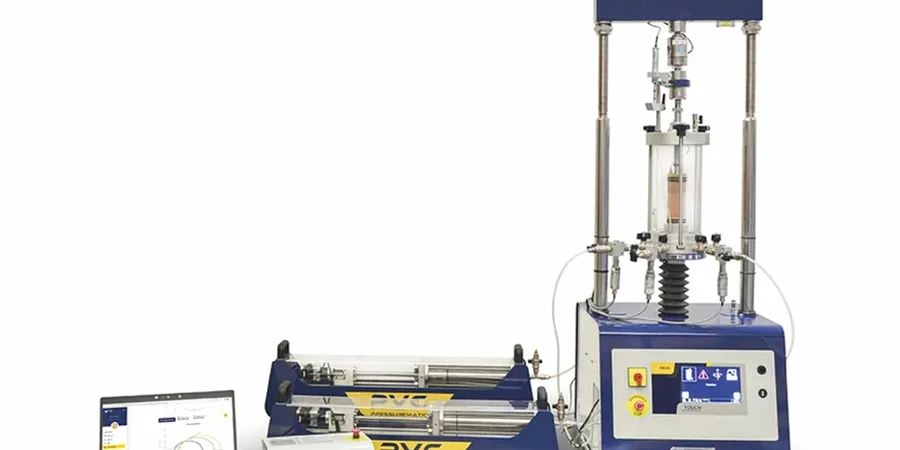
Typical technical challenges in Bournemouth
Eurocode 7 (BS EN 1997-2:2007) mandates that the selection of characteristic shear strength values must account for the brittleness of the soil and the consequence class of the structure. Along Bournemouth’s cliffed coastline, a misinterpretation of triaxial data for the Chalk or the overlying drift can lead to an unconservative assessment of slope stability, especially where relic shear surfaces exist from historical landslides. The risk intensifies in excavations near the town centre, where a CU test that underestimates pore pressure build-up can mask a dangerously low effective stress state. We apply the guidance of CIRIA C760 and the relevant clauses of BS 5930:2015+A1:2020 to ensure that the triaxial programme is designed for the specific failure mechanism, whether it is bearing capacity, retaining wall rotation, or slope failure.
Our services
The triaxial test is rarely an isolated scope item. For a complete ground model in Bournemouth, we bundle the advanced shear testing with the following complementary works:
Sample Preparation and Logging
Extrusion, trimming, and detailed logging of U100 or rotary core samples from Bournemouth sites, with classification to BS 5930 including density, moisture content, and consistency index before triaxial setup.
Consolidation and Permeability Testing
Oedometer consolidation tests on the Poole Clay and Branksome Sand to determine the pre-consolidation pressure and constrained modulus, coupled with triaxial permeability measurement at the relevant stress level.
Common questions
What is the typical timeframe for a triaxial test programme in Bournemouth?
A single CU triaxial test on a cohesive soil from Bournemouth typically requires 7 to 10 working days from sample receipt to the final report, accounting for the saturation, consolidation, and shearing stages. A multi-stage test or a CD test on a fine-grained soil can extend to 14 days due to the slow strain rate required for drained conditions.
How much does a triaxial test cost for a project in Bournemouth?
A standard single-stage triaxial test (CU or UU) on a 100 mm specimen ranges from £1,600 to £2,420, depending on the consolidation stress levels and the number of cycles. A CD test with multiple stages is at the upper end of this range. We deliver a fixed-price quotation after reviewing the borehole logs and the required stress range.
Which type of triaxial test is appropriate for the Poole Clay?
For the Poole Clay, a consolidated undrained (CU) test with pore pressure measurement is the most appropriate, because it allows us to derive effective stress parameters (c' and φ') while also capturing the undrained shear strength for short-term loading scenarios. If the structure imposes long-term drained conditions, a CD test should supplement the CU programme.
Can you test granular soils like the Branksome Sand in the triaxial cell?
Yes, we perform triaxial tests on the Branksome Sand using a remoulding technique at the target density. The specimen is saturated with a back-pressure procedure, and a CD test is typically specified to obtain the peak effective friction angle for the design of shallow footings and retaining structures in Bournemouth.