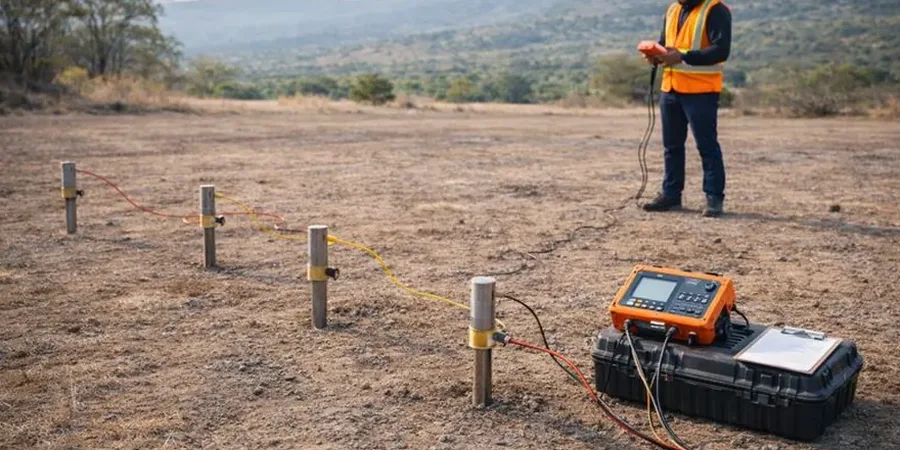
BS 5930:2015 and Eurocode 7 (BS EN 1997-2:2007) deliver the framework for electrical resistivity surveys, yet in Bournemouth the interplay between coastal hydrogeology and the Branksome Sand Formation creates conditions where generic reconnaissance falls short. With a population exceeding 195,000 and ongoing regeneration along the Christchurch Road corridor, developers face ground investigation demands that cannot be met by trial pitting alone. The Vertical Electrical Sounding method resolves stratigraphic boundaries across the Poole Formation sequence, distinguishing between saturated sand lenses and intact sandy clay with the resolution needed for pile design and cut-and-cover excavations. We run Schlumberger and Wenner array configurations from our mobile resistivity unit, processing data with RES2DINV to deliver true resistivity cross-sections tied to borehole control points within Bournemouth's five wards. Where shallow refusal limits mechanical investigation, combining VES with test pits provides lithological calibration across the meter-scale variability typical of Christchurch Member deposits.
Apparent resistivity measurements lose meaning without geological constraint: a 25 Ωm anomaly in Bournemouth could be saline sand, saturated clay, or a gravel lens. Calibration against physical borehole logs resolves the ambiguity before excavation begins.
Service characteristics in Bournemouth
Procedure video
Typical technical challenges in Bournemouth
Bournemouth sits at approximately 32 metres OD at its highest point, sloping to sea level across less than 3 kilometres, a gradient that accelerates groundwater flow and promotes solution weathering within the Chalk bedrock underlying the Quaternary sequence. Over 60% of the borough's groundwater supply derives from the Bournemouth Aquifer, and any excavation exceeding 3 metres depth intercepts perched water tables that resistivity surveys readily identify as low-resistivity horizons. The risk of encountering karstic voids in the Chalk-Paleogene interface is well-documented across the Wessex Basin: sinkhole collapse features have required emergency remediation along the A338 corridor. VES profiling detects air-filled cavities as high-resistivity anomalies exceeding 800 Ωm, while clay-filled dissolution pipes present an intermediate signature that only a calibrated resistivity survey can distinguish from intact bedrock. Where the London Clay Formation pinches out beneath Bournemouth's northern suburbs, the transition to permeable Bagshot Sands creates a recharge boundary that concentrates infiltration — and with it the risk of sudden groundwater ingress during basement construction.
Our services
Resistivity surveys in Bournemouth are configured to answer specific geotechnical questions, not to generate generic colour sections. Each investigation design starts with the geological model and works backward to electrode geometry.
VES Sounding Campaigns for Foundation Design
Single-point Vertical Electrical Soundings at pile locations and along spread footing alignments, resolving the depth to the Branksome Sand / Poole Formation boundary with ±0.5-metre vertical accuracy when calibrated against one borehole per 1,500 square metres. We deliver VES curves with interpreted layer thicknesses and resistivity values, formatted for direct input into bearing capacity calculations under BS EN 1997-1.
2D Resistivity Tomography for Retaining Wall Alignments
Multi-electrode Wenner or dipole-dipole profiling to 15–25 metres depth, identifying lateral changes in lithology, perched water, and buried channel features that would undermine sheet pile or secant pile wall performance. Sections are georeferenced to OSGB36 coordinates and superimposed on site plans for design team integration.
Groundwater and Salinity Mapping
Conductivity-depth profiling to delineate the freshwater-saltwater interface in coastal sites below 5 metres OD, critical for basement waterproofing design and dewatering system specification. We combine resistivity with in-situ water conductivity measurements to produce iso-resistivity contour maps at target depths.
Common questions
What depth can a VES survey reach in Bournemouth's geology?
With a 300- to 400-metre current electrode spread, investigation depths of 60 to 80 metres are achievable in the Poole Formation sands and underlying Chalk. Practical depth is limited by the site geometry and the presence of buried works; urban Bournemouth sites typically constrain spreads to 150 metres, yielding 25 to 35 metres of penetration, which is sufficient to reach the Chalk interface across most of the borough.
How much does a resistivity survey cost for a typical Bournemouth site?
A VES campaign or 2D resistivity line on a standard residential-commercial plot in Bournemouth ranges from £470 to £740, depending on the number of soundings, array configuration, and whether topographic correction is required. Sites with steep gradients — common in the East Cliff and West Cliff areas — fall toward the upper end due to additional survey control and processing time.
Can resistivity distinguish between sand and clay in the Branksome Sand Formation?
Yes, with the important caveat that water saturation strongly controls the contrast. Dry Branksome Sand typically registers 300 to 600 Ωm, while saturated sandy clay in the same formation drops to 20 to 50 Ωm. The boundary is unambiguous when calibrated against at least one borehole or trial pit log. Where pore water is saline — within 500 metres of the Bournemouth coastline — the sand-clay resistivity contrast compresses, and we supplement resistivity with CPT or borehole control for reliable discrimination.
What array configuration works best for karst detection in the Chalk?
Dipole-dipole arrays with 5- to 10-metre electrode spacing deliver the lateral resolution needed to detect air-filled dissolution features in the Chalk, which present as high-resistivity anomalies exceeding 800 Ωm against a background of 80 to 150 Ωm for intact, moderately fractured Chalk. We typically run both Wenner and dipole-dipole on the same spread to balance depth resolution against lateral sensitivity, processing both datasets through a combined inversion in RES2DINV.